
SEARCH WHAT YOU WANT

Temperature / Humidity
Bench-top Environmental Chambers
Temperature and humidity Test Chambers
Battery explosion-proof test chamber
Walk in chamber
AGREE Chambers
Thermal Vacuum Chamber
Thermal / Stress
Thermal Shock Chamber
ESS Test Chambers
HALT chamber
Altitude Test Chambers
Life/Aging
Explosion-Proof Oven
Inert Gas Oven
Precision Industrial Oven
Salt Spray Test Chambers
Sand and Dust Test Chambers
Rain Test Chambers
Ultraviolet Aging Test Chambers
Walk-In Aging Test Room
Microwave Digestion System
Other Environments
Double-arms Drop Test Machine
Single-arm Drop Test Machine
Impact Testing Machine
Simulation Car Transport Vibration Tester
High And Low Temperature Tension Test Machine
Battery Heavy Impact Test chamber
Battery Nail Penetration And Squeezing Combined chamber
Battery Internal Short Circuit chamber
Battery Washing Test chamber
Battery Rotation Test chamber
Pharmaceutical Stability Chambers
Explosion-proof Oven
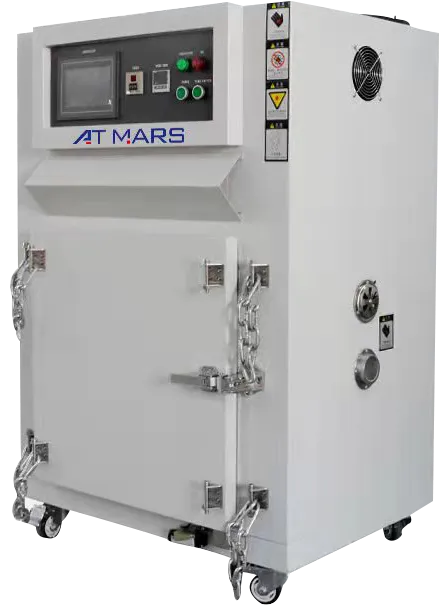
AtMars Battery Explosion-Proof Oven: Safeguarding the Energy Revolution
A Battery Explosion-Proof Oven is a critical piece of industrial equipment specifically engineered for the safe thermal processing of lithium-ion batteries and other energy storage devices during manufacturing (e.g., electrolyte drying, formation cycling, aging) and failure analysis. Its primary function is to prevent catastrophic thermal runaway events and contain any potential internal fires or explosions that may occur due to battery defects, short circuits, or off-gassing of volatile electrolytes.
Safety is achieved through a multi-layered approach. The oven features a heavy-duty, pressure-rated chamber constructed with reinforced walls and a blast-proof door. All internal electrical components, including heating elements and circulation fans, are housed in UL/ATEX-certified explosion-proof enclosures to eliminate ignition sources. Advanced inert atmosphere systems are often integrated, allowing the chamber to be purged with nitrogen or argon to displace oxygen, drastically reducing combustion risk. Comprehensive safety interlocks monitor for temperature spikes, pressure surges, and the presence of volatile organic compounds (VOCs), triggering immediate shutdown and suppression protocols.
These ovens are essential for battery R&D labs, cell production facilities, and quality control centers, enabling safe high-temperature cycling, degassing, and stability testing. By providing a controlled and intrinsically safe environment, they protect personnel, capital equipment, and facilities, allowing for the necessary thermal stress testing that drives innovation and ensures the reliability of modern battery technologies.
We design safety features for our oven according to following EUCAR Hazard Levels:
| Description | Description | Classification Level & Effect |
|---|---|---|
| 0 | No effect | No effect. No loss of functionality |
| 1 | Passive protection activated | No defect; no leakage; no venting, fire or flame; no rupture; no explosion; no exothermic reaction or thermal runaway. Cell reversibly damaged. Repair of protection device needed. |
| 2 | Defect/ Damage | No leakage; no venting, fire or flame; no rupture; no explosion; no exothermic reaction or thermal runaway. Cell irreversibly damaged. Repair needed. |
| 3 | Leakage, mass change < 50% | No venting, fire or flame; no rupture; no explosion. Weight loss <50% of electrolyte weight (electrolyte = solvent + salt). |
| 4 | Venting, mass change ≥ 50% | No fire or flame; no rupture; no explosion. Weight loss ≥50% of electrolyte weight (electrolyte = solvent + salt). |
| 5 | Fire or flame | No rupture; no explosion (i.e. no flying parts). |
| 6 | Rupture | No explosion, but flying parts of the active mass. |
| 7 | Explosion | Explosion (i.e. disintegration of the cell). |
AtMars Battery Explosion-Proof Oven: Safeguarding the Energy Revolution
A Battery Explosion-Proof Oven is a critical piece of industrial equipment specifically engineered for the safe thermal processing of lithium-ion batteries and other energy storage devices during manufacturing (e.g., electrolyte drying, formation cycling, aging) and failure analysis. Its primary function is to prevent catastrophic thermal runaway events and contain any potential internal fires or explosions that may occur due to battery defects, short circuits, or off-gassing of volatile electrolytes.
Safety is achieved through a multi-layered approach. The oven features a heavy-duty, pressure-rated chamber constructed with reinforced walls and a blast-proof door. All internal electrical components, including heating elements and circulation fans, are housed in UL/ATEX-certified explosion-proof enclosures to eliminate ignition sources. Advanced inert atmosphere systems are often integrated, allowing the chamber to be purged with nitrogen or argon to displace oxygen, drastically reducing combustion risk. Comprehensive safety interlocks monitor for temperature spikes, pressure surges, and the presence of volatile organic compounds (VOCs), triggering immediate shutdown and suppression protocols.
These ovens are essential for battery R&D labs, cell production facilities, and quality control centers, enabling safe high-temperature cycling, degassing, and stability testing. By providing a controlled and intrinsically safe environment, they protect personnel, capital equipment, and facilities, allowing for the necessary thermal stress testing that drives innovation and ensures the reliability of modern battery technologies.
We design safety features for our oven according to following EUCAR Hazard Levels:
| Description | Description | Classification Level & Effect |
|---|---|---|
| 0 | No effect | No effect. No loss of functionality |
| 1 | Passive protection activated | No defect; no leakage; no venting, fire or flame; no rupture; no explosion; no exothermic reaction or thermal runaway. Cell reversibly damaged. Repair of protection device needed. |
| 2 | Defect/ Damage | No leakage; no venting, fire or flame; no rupture; no explosion; no exothermic reaction or thermal runaway. Cell irreversibly damaged. Repair needed. |
| 3 | Leakage, mass change < 50% | No venting, fire or flame; no rupture; no explosion. Weight loss <50% of electrolyte weight (electrolyte = solvent + salt). |
| 4 | Venting, mass change ≥ 50% | No fire or flame; no rupture; no explosion. Weight loss ≥50% of electrolyte weight (electrolyte = solvent + salt). |
| 5 | Fire or flame | No rupture; no explosion (i.e. no flying parts). |
| 6 | Rupture | No explosion, but flying parts of the active mass. |
| 7 | Explosion | Explosion (i.e. disintegration of the cell). |
FEEDBACK