
SEARCH WHAT YOU WANT

ESS Test Chamber
About ESS Test Chamber?
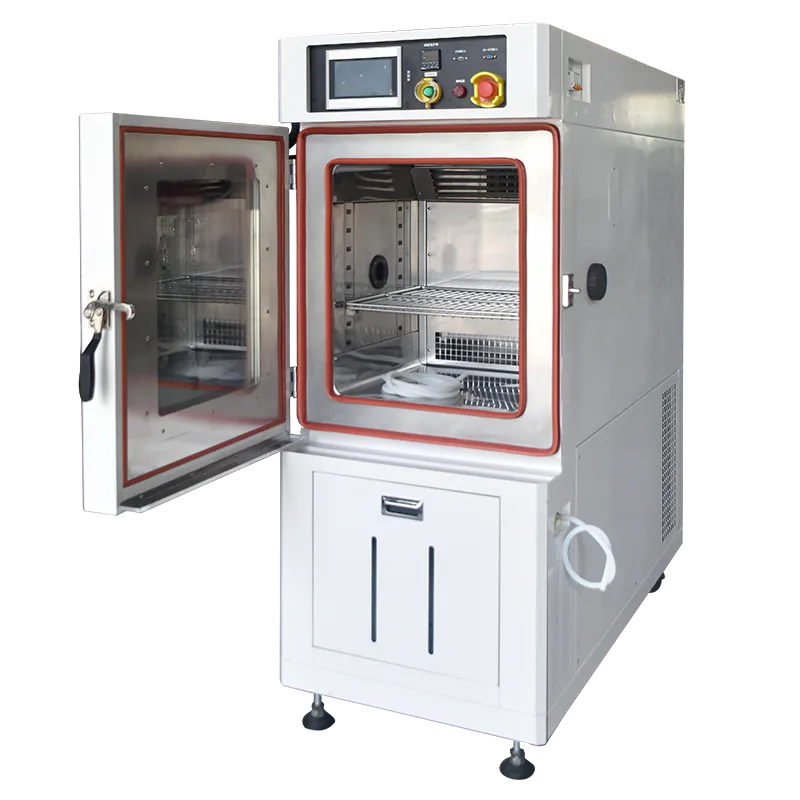
Environmental Stress Screening (ESS) chambers are advanced testing systems designed to detect early-life failures and manufacturing defects in products by exposing them to accelerated environmental conditions
ESS chamber, the fast track to product reliability
In today's competitive industries, early detection of defects is not just a quality concern—it's a strategic advantage. An ESS chamber (Environmental Stress Screening chamber) plays a critical role in identifying weaknesses in electronic and mechanical components before they reach the end user. By applying accelerated thermal and/or mechanical stresses, ESS testing allows manufacturers to ensure high reliability and reduce costly failures in the field.
What is an ESS chamber?
An ESS chamber is a type of environmental test chamber specifically designed to simulate extreme variations in temperature, humidity, or vibration over short cycles. These rapid changes expose latent defects in products, especially in sensitive components like PCBs, sensors, and assemblies used in high-reliability sectors. Unlike standard climatic chambers, ESS chambers are engineered for speed and intensity, delivering faster transition rates and tighter control of environmental parameters.
Why use ESS testing
The primary goal of ESS testing is to identify early-life failures—defects that may not surface under normal quality control conditions. By subjecting products to extreme conditions in a compressed timeframe, engineers can:
Reduce field returns and warranty costs
Increase product lifespan and stability
Improve customer satisfaction
Accelerate the qualification process
This method is especially valuable in mass production and quality assurance workflows, where high throughput and repeatability are key.
Who are ESS Testing for
ESS testing is widely used in electronics, where solder joints, microchips and capacitors are prone to thermal fatigue or hidden faults. In automotive applications, it helps validate electronic control units (ECUs), battery modules or sensors under demanding conditions. The aerospace industry also relies on ESS chambers to ensure the safety and durability of avionic components subject to extreme temperature shifts during flight cycles.
For industries where reliability is non-negotiable, an ESS chamber becomes a critical step in the product development and validation pipeline.
Contact Atmars, we offer a range of high-performance ESS chambers designed for rapid temperature transitions and precise control. Whether you need a standalone unit or a custom configuration, our equipment is tailored to meet stringent industrial standards
About ESS Test Chamber?
Environmental Stress Screening (ESS) chambers are advanced testing systems designed to detect early-life failures and manufacturing defects in products by exposing them to accelerated environmental conditions
ESS chamber, the fast track to product reliability
In today's competitive industries, early detection of defects is not just a quality concern—it's a strategic advantage. An ESS chamber (Environmental Stress Screening chamber) plays a critical role in identifying weaknesses in electronic and mechanical components before they reach the end user. By applying accelerated thermal and/or mechanical stresses, ESS testing allows manufacturers to ensure high reliability and reduce costly failures in the field.
What is an ESS chamber?
An ESS chamber is a type of environmental test chamber specifically designed to simulate extreme variations in temperature, humidity, or vibration over short cycles. These rapid changes expose latent defects in products, especially in sensitive components like PCBs, sensors, and assemblies used in high-reliability sectors. Unlike standard climatic chambers, ESS chambers are engineered for speed and intensity, delivering faster transition rates and tighter control of environmental parameters.
Why use ESS testing
The primary goal of ESS testing is to identify early-life failures—defects that may not surface under normal quality control conditions. By subjecting products to extreme conditions in a compressed timeframe, engineers can:
Reduce field returns and warranty costs
Increase product lifespan and stability
Improve customer satisfaction
Accelerate the qualification process
This method is especially valuable in mass production and quality assurance workflows, where high throughput and repeatability are key.
Who are ESS Testing for
ESS testing is widely used in electronics, where solder joints, microchips and capacitors are prone to thermal fatigue or hidden faults. In automotive applications, it helps validate electronic control units (ECUs), battery modules or sensors under demanding conditions. The aerospace industry also relies on ESS chambers to ensure the safety and durability of avionic components subject to extreme temperature shifts during flight cycles.
For industries where reliability is non-negotiable, an ESS chamber becomes a critical step in the product development and validation pipeline.
Contact Atmars, we offer a range of high-performance ESS chambers designed for rapid temperature transitions and precise control. Whether you need a standalone unit or a custom configuration, our equipment is tailored to meet stringent industrial standards