
SEARCH WHAT YOU WANT

AGREE Environmental Vibration Comprehensive Test Chamber: Technical Principle and Performance Characteristics
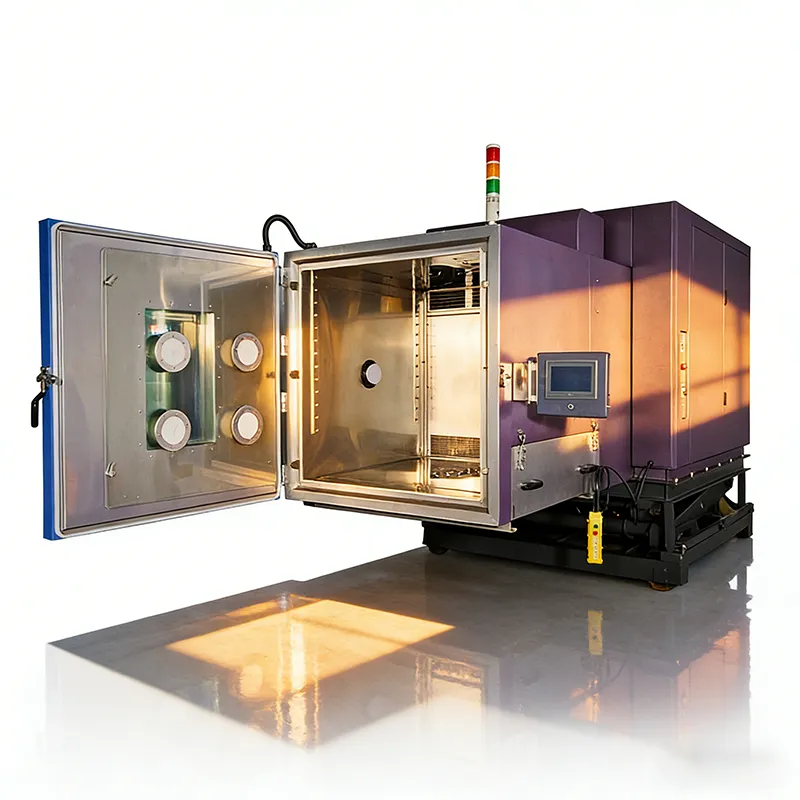
The AGREE temperature, humidity and vibration integrated test chamber is a professional composite environmental test equipment tailored for high-reliability verification scenarios in aerospace, aviation, petrochemical, electronic communication and other high-end industrial fields. Different from single-factor environmental test equipment, this equipment integrates temperature-humidity climate simulation and electrical vibration stress loading functions. It can synchronously apply alternating temperature-humidity environmental stress and cyclic vibration mechanical stress to test specimens including complete equipment, electronic components, precision instruments and industrial materials under a coupled working condition.
The equipment is core to comprehensive environmental stress screening (ESS) and adaptability verification. It can truly reproduce the multi-field coupled service environment of products during transportation, storage and actual operation. Compared with single-factor independent test modes, the composite stress test can effectively excise potential latent defects such as structural fatigue, material aging and electrical performance drift caused by the coupling of temperature, humidity and vibration. It serves as an essential verification carrier for full-process R&D iteration, prototype performance appraisal and product qualification certification of high-reliability electronic and electrical products, and provides accurate and credible test data basis for product environmental adaptability optimization and reliability improvement.
Core Technical Characteristics
1. High-efficiency Independent Refrigeration & Air Circulation System
The refrigeration unit adopts a fully enclosed high-efficiency compressor, matched with single/dual low-temperature loop modular design, which realizes efficient and stable low-temperature environment simulation and meets the requirements of continuous and long-cycle test conditions. The core refrigeration accessories are equipped with internationally renowned brand components, including American high-precision dry filters and oil separators, and Italian high-stability solenoid valves, which effectively improve the filtration accuracy of the refrigeration system, avoid pipeline blockage and oil return failure, and significantly enhance the overall operational stability and service life of the refrigeration loop.
In terms of air circulation, the equipment is equipped with a multi-blade high-power exhaust fan, combined with a professional outflow and return air circulation structure. This design eliminates temperature and humidity dead zones in the test working chamber, realizes full-space uniform distribution of temperature and humidity field. The air pressure and flow velocity in the cabin strictly comply with industry test standards, and support rapid temperature and humidity recovery and stabilization after door opening and sample replacement, greatly improving test efficiency and data repeatability.
The heating, refrigeration and humidification subsystems adopt a fully independent structural layout. The independent control of each functional subsystem avoids mutual interference during operation, effectively improves the response efficiency of environmental adjustment, reduces equipment energy consumption and test cost, and lowers component load and system failure rate, realizing long-term stable high-intensity operation of the equipment.
2. High-Precision Intelligent Constant Control System
The equipment is equipped with a dual-channel high-precision digital PID microcomputer intelligent controller, which breaks the limitation of traditional temperature-humidity conversion and calibration. It can directly output and display real-time humidity percentage values, realizing high-precision synchronous monitoring and control of temperature and humidity parameters. The whole temperature control process adopts PID+SSR channel coordinated control algorithm, which optimizes the parameter adjustment logic, effectively improves the static stability and dynamic response performance of the control system, and reduces the loss of control modules and signal interfaces.
The system supports full touch human-computer interaction setting and digital real-time direct display of parameters, with intuitive operation and clear data. Built-in PID automatic operation calculation function can adaptively match optimal control parameters according to different test conditions and specimen characteristics, avoiding test errors and efficiency loss caused by manual parameter debugging.
In terms of operational safety and data traceability, the system is configured with complete abnormal alarm logic. It can automatically trigger alarm prompts for parameter setting errors, operational faults and environmental anomalies during equipment operation. It is equipped with a 5-year long-term power-off data storage module, which can record and retain test data and operation logs before power failure, and support automatic continuation of the remaining test procedures after power recovery, ensuring the integrity and continuity of long-cycle reliability test data.
The AGREE temperature, humidity and vibration integrated test chamber is a professional composite environmental test equipment tailored for high-reliability verification scenarios in aerospace, aviation, petrochemical, electronic communication and other high-end industrial fields. Different from single-factor environmental test equipment, this equipment integrates temperature-humidity climate simulation and electrical vibration stress loading functions. It can synchronously apply alternating temperature-humidity environmental stress and cyclic vibration mechanical stress to test specimens including complete equipment, electronic components, precision instruments and industrial materials under a coupled working condition.
The equipment is core to comprehensive environmental stress screening (ESS) and adaptability verification. It can truly reproduce the multi-field coupled service environment of products during transportation, storage and actual operation. Compared with single-factor independent test modes, the composite stress test can effectively excise potential latent defects such as structural fatigue, material aging and electrical performance drift caused by the coupling of temperature, humidity and vibration. It serves as an essential verification carrier for full-process R&D iteration, prototype performance appraisal and product qualification certification of high-reliability electronic and electrical products, and provides accurate and credible test data basis for product environmental adaptability optimization and reliability improvement.
Core Technical Characteristics
1. High-efficiency Independent Refrigeration & Air Circulation System
The refrigeration unit adopts a fully enclosed high-efficiency compressor, matched with single/dual low-temperature loop modular design, which realizes efficient and stable low-temperature environment simulation and meets the requirements of continuous and long-cycle test conditions. The core refrigeration accessories are equipped with internationally renowned brand components, including American high-precision dry filters and oil separators, and Italian high-stability solenoid valves, which effectively improve the filtration accuracy of the refrigeration system, avoid pipeline blockage and oil return failure, and significantly enhance the overall operational stability and service life of the refrigeration loop.
In terms of air circulation, the equipment is equipped with a multi-blade high-power exhaust fan, combined with a professional outflow and return air circulation structure. This design eliminates temperature and humidity dead zones in the test working chamber, realizes full-space uniform distribution of temperature and humidity field. The air pressure and flow velocity in the cabin strictly comply with industry test standards, and support rapid temperature and humidity recovery and stabilization after door opening and sample replacement, greatly improving test efficiency and data repeatability.
The heating, refrigeration and humidification subsystems adopt a fully independent structural layout. The independent control of each functional subsystem avoids mutual interference during operation, effectively improves the response efficiency of environmental adjustment, reduces equipment energy consumption and test cost, and lowers component load and system failure rate, realizing long-term stable high-intensity operation of the equipment.
2. High-Precision Intelligent Constant Control System
The equipment is equipped with a dual-channel high-precision digital PID microcomputer intelligent controller, which breaks the limitation of traditional temperature-humidity conversion and calibration. It can directly output and display real-time humidity percentage values, realizing high-precision synchronous monitoring and control of temperature and humidity parameters. The whole temperature control process adopts PID+SSR channel coordinated control algorithm, which optimizes the parameter adjustment logic, effectively improves the static stability and dynamic response performance of the control system, and reduces the loss of control modules and signal interfaces.
The system supports full touch human-computer interaction setting and digital real-time direct display of parameters, with intuitive operation and clear data. Built-in PID automatic operation calculation function can adaptively match optimal control parameters according to different test conditions and specimen characteristics, avoiding test errors and efficiency loss caused by manual parameter debugging.
In terms of operational safety and data traceability, the system is configured with complete abnormal alarm logic. It can automatically trigger alarm prompts for parameter setting errors, operational faults and environmental anomalies during equipment operation. It is equipped with a 5-year long-term power-off data storage module, which can record and retain test data and operation logs before power failure, and support automatic continuation of the remaining test procedures after power recovery, ensuring the integrity and continuity of long-cycle reliability test data.